



Of Chance Finds, Shared discoveries
Or the oft asked question: What is good design, really?
Back in the early 90s when my friend Suzie was leaving to do her Masters, I gifted her a book I found while browsing at a second-hand bookstore to read on the plane ride. I chose it for its size – a pocket-sized paperback – and because it had the word, ‘chocolate’ on its dark cover. I did not want to burden her in any way as she took flight. When Suzie returned she asked, in her inimitable Suzie-way, “Hey Sari, do you remember the book you gave me? Did you know then that was the big hit it was?” That book, ‘Like Water for Chocolate’, she and I separately discovered, had become the rage in the then popular genre, magical realism. However, for me that book is forever linked to Suzie and her leaving Bangalore, – and also to the secret joy of discovering a book with no reviewer or friend proclaiming it a ‘must read’.
Today many of us have more books on our shelves than we have read or will read. On my shelf however, I recently re-discovered another treasure from the early 90s while looking for references to give Savithri, my young intern: a thick, hard-bound edition of Bertrand Russell’s, ‘Wisdom of the West’. My brother had brought it back from his trip abroad – along with many others not easily available in those pre-Amazon days. We had many editions of Russell’s books at home: my father was a fan. Even as Russell’s books were intended to be accessible, the complex ideas on relativity and religion would often go way above my teenage head. But this edition was special; while the writing was accessible enough, it had little drawings all along the margins, illustrating complex concepts in philosophical thought.
As Savithri and I pored through the book, we marvelled at its merits in making visual and conceptual connections across epochs of philosophical thought. When I first browsed through the book in the 90s, I hadn’t given much thought to who the designer was. Today, armed with a curiosity for design histories, I looked him up online. Edward Wright, I discovered, was one of the lesser known of the band of designers whose work had always interested me. This group, spearheaded by Ken Garland, had published ‘The First Things First Manifesto’, raised the consciousness of design’s role in industry, and also waged against the homogeneity that certain big-business jobs bring. In Garland’s words: “We think that there are other things more worth using our skill and experience on”.
We, and those we design for, seek grand entries and monumental statements in our designs – bold colours and things of great aesthetic significance. But we often forget what good design can actually do – one of them being – to aid the simplification of complex, didactic information and to help individual readers find things that are of particular significance – such as finding their own unique stories within the pages of a book.
My re-discovery of ‘Wisdom of the West’ was a reminder of what design can achieve in a humble, understated fashion. The information design in this book does not deal with big data, it is not in the style that is in vogue today: big bubbles and silhouettes spilling out of magazines, annual reports and student portfolios, characterised by vector graphics and easy reproducibility. Instead, in the book are images that have a lateral approach to information – rather than rendering what was in the text – these images take a step sideways, making for a new reading of the text, provoking readers to think, rather than laying it all out easy. I like to think the book interprets visually not what Russell thought but the way Russell thought.
Now, wouldn’t it be nice to have books like these in our education systems? For now, I will associate this book with teenage nerdiness, chance discoveries – and young Savithri.
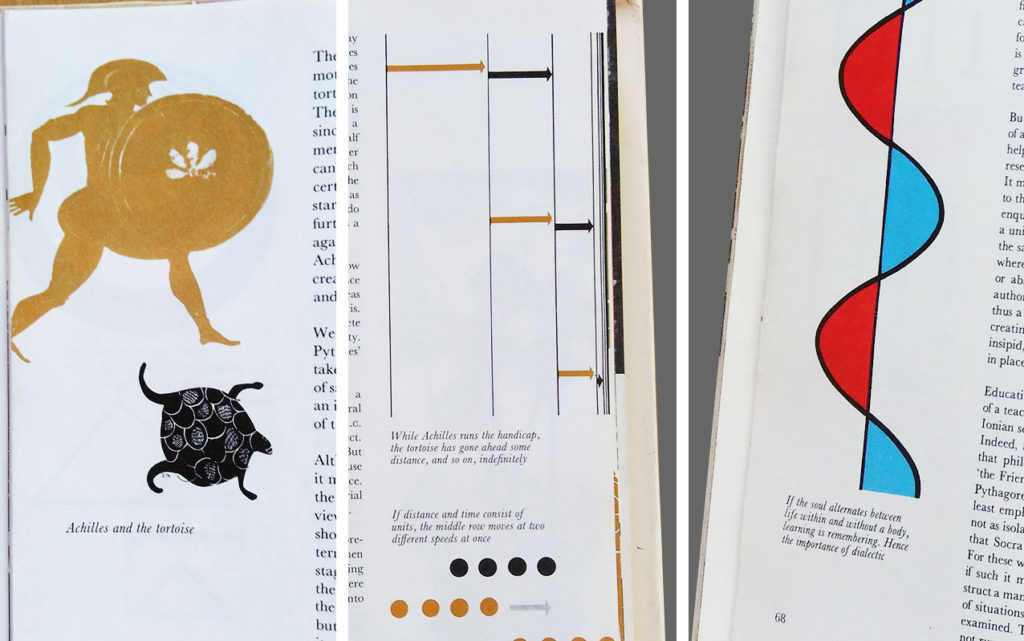
Books like “Wisdom of the West…” to some extent inspire the way I’d like to work – and the approach on book projects such as the ‘History of Sustainability’, ‘So that All May See’ and more recently ‘With Great Truth and Regard’ and ‘A World without a Roof’